family history

Hour Glass Chart for Louis and Louise Schillinger

I created a family hourglass chart to illustrate how the Schillinger generations go. I’ve also created a family group record as a .pdf file that has more information than last night’s post. To explain:

  • An hourglass chart shows both the ancestors and descendants of the couple at the center of the hourglass.  In this case, I’m showing all the information about the known ancestors, but I have limited the descendants to 2 generations and blanked out the information on the one living person (my Pop) for privacy reasons.
  • A family group record is all the information about one family laid out in a very organized fashion and is a standard form in genealogical research.  In this case, I’m only including the FGR for Louis F. Schillinger and his wife, which will include their children, but not their ancestors or their descendants beyond their children.  I’ve only included notes from Louis and his wife.
Pedigree Chart Louis F Schillinger

Pedigree Chart Louis F Schillinger

Louis F Schillinger Family Group Record

Louis F Schillinger Family Group Record

Enhanced by Zemanta

Xaver Schillinger’s Death Certificate

I found a reference to Xaver Schillinger’s death certificate in the New York, New York, Death Index, 1862-1948 on Ancestry.com.  The reference gave me the certificate number, which I then obtained from the NYC Municipal Archives.  It arrived in the mail yesterday!

Xaver Schillinger Death Certificate

Xaver Schillinger Death Certificate

So let’s take a look at what we can learn from his death certificate.

1.  Xaver Schillinger died at Brooklyn Hospital. (The Brooklyn Hospital is located at 121 DeKalb Avenue in Brooklyn.

Xaver Schillinger Death Certificate - Annotation 1

Xaver Schillinger Death Certificate Annotation 1

2. The death certificate confirms, not only the date of death, his sex and race, but it also confirms that his wife Catherine predeceased him.  This allows me to look for her death records sometime between when she last shows up in a census (1900) and his year of death (1923).

Xaver Schillinger Death Certificate Annotation 2

Xaver Schillinger Death Certificate Annotation 2

3.  I have his approximate year of birth as 1836.  His death certificate lists his age as 87.  Since he died in 1923 (1923-87=1836), his death certificate agrees with what I know to be his birth year.  Unfortunately, it does not list the months or day, nor does it list his specific birth date, so I cannot confirm his birth beyond the year.

Xaver Schillinger Death Certificate Annotation 3

Xaver Schillinger Death Certificate Annotation 3

4. The death certificates agrees that he is an immigrant from Germany and it lists his number of years in the United States as 62.  This would place his year of immigration as 1861.  My previous records had his immigration occurring in 1860, with his enlistment in the US Army by March 1861.  So his death certificate is consistent (within 1 year) of the information I already had on record.  Taking in to account that the information on the death certificate is being reported by a 3rd party (his daughter Catherine), who was not alive at the time of his immigration, I am satisfied that the record is consistent with other documentation.

Xaver Schillinger Death Certificate Annotation 4

Xaver Schillinger Death Certificate Annotation 4

5. The death certificated gives me his parents’ names!  This is probably the most exciting piece of information on the document.  I had his parents listed as “Franz Xaver Schillinger” and “Franziska Stockel”.  Now these names are close, but I never had documentation of these names – just information from other people’s family trees.  This is the first official record that I’ve come across with their names on it.  It’s important to note that his father is not listed as Franz, but as Xaver.  The one issue I’ve had is that I have found no documentation for this Xaver to have a first name of Franz either, though that is how I’ve come across him being recorded in others’ trees.  Also, his mother’s last name is spelled with an “a” on the death certificate, not an “o”.  These are great leads for tracking down more information about the family in Germany, as neither of his parents appear to have immigrated to the United States.

Xaver Schillinger Death Certificate Annotation 5

Xaver Schillinger Death Certificate Annotation 5

6. His residence at his time of death was 148 Logan Street.  This is consistent with my other records.  In the 1920 census, he is listed as living with his daughter Catherine Fausner (who is also the reporting party on the death certificate) at the Logan Street address.  This information helps to confirm that I have the death certificate for the correct person.

Xaver Schillinger Death Certificate Annotation 6

Xaver Schillinger Death Certificate Annotation 6

7.  Xaver Schillinger was in the hospital from 2 Oct 1923 until 6 Oct 1923, when he passed away at 12:30pm.  He was attended by Dr. T.M. Dudley.  His cause of death is: “right strangulated femoral hernia.  Left sliding inguinal hernia. Hernioplasty.”  The duration of the condition is listed as “many” years.  A contributing/secondary cause of death is listed as “broncho pneumonia“.  So it would appear that Xaver went to the hospital to have to hernias repaired, one of which, at least, is a very serious condition.  The right strangulated femoral hernia can cause the blood to be cut off to the bowels and result in necrosis – which is life threatening.  His stay in the hospital was complicated by a bout of pneumonia, which was even made more dangerous because of his age.

Xaver Schillinger Death Certificate Annotation 7

Xaver Schillinger Death Certificate Annotation 7

8. He is buried at Holy Trinity Cemetery.  I had found a previous reference to an Xaver Schillinger being buried in Trinity Cemetery, but had no confirmation which Trinity Cemetery or that it was my Xaver Schillinger.  The death certificate is consistent with the burial record I found, which also includes the plot information (Block 5, Row 6).  Most Holy Trinity Cemetery is located next to The Evergreens Cemetery on Central Avenue in Brooklyn.

Xaver Schillinger Death Certificate Annotation 8

Xaver Schillinger Death Certificate Annotation 8

Enhanced by Zemanta

Happy Genealogy Day – What genealogy means to me

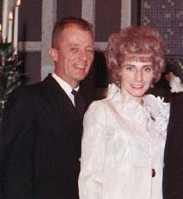
Nan and Pop

Nan and Pop

When I was 7 years old, my family moved away from my dad’s extended family.  As a result, we did not see them nearly as often as we used to and I didn’t develop the types of relationships with my grandparents, my aunts and uncles, and my cousins that I should otherwise have had with them.

Mammaw and Pappaw

Mammaw and Pappaw

On my mother’s side of the family, my mother was largely estranged from her parents, well mostly her mother.  They had a very difficult relationship and generally did not get along.  I can probably count the number of times I saw my maternal grandparents on two hands.  As a result, I feel like I have missed out on what I might have learned about our family history from them.

Genealogical research feels a fairly significant void in how I feel connected to my family.  Be seeking out information about my family, I’ve discovered things that have allowed me to feel connection to family going back for generations. My ancestors come alive in photographs, stories, diaries, and official records.  I learn of my 3rd great grandfather Michael Reilly who had his grandchildren living in his home with him after their father disappeared while riding a New York ferry.  I discover my 2nd great grandfather Louis F. Schillinger was a prolific architect, who designed many of the turn-of-the-century brownstones in the East New York neighborhood of Brooklyn.  I find my 3rd great grandfather James Jackson Johns fought for the 30th Georgia Infantry during the Civil War, and died a poor invalid in 1917 due to an illness he contracted during the war.  I found the gravestone for my great  grandparents Marion and Lela Douglas, confirming information about Marion when before I only had his name.  I’ve also made connections with distant cousins, with whom I share a common ancestor.  Genealogy has provided me a way to learn about and feel more connected to the rich history of my family.

Happy Genealogy Day!  And good luck to everyone in their own family history quest!


Enhanced by Zemanta

How-To Presentations & Companion Guides

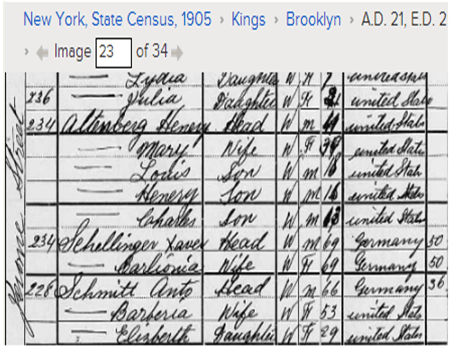
Xaver Schillinger in the 1905 New York State Census

Xaver Schillinger in the 1905 New York State Census

I’m launching a new series of How-To Presentations and Companion Guides.  I was inspired by my recent experience looking and finding my 3rd great-grandfather Xaver Schillinger in the 1905 New York State Census.  Using my real world example, I take you step-by-step through the process I used to locate him – a difficult task since he did not come up in a routine search using FamilySearch.org’s search engine.  I ended up having to manually search for him in the census, because his name and those of his family members were butchered by the enumerator recording the census.  However, I was able to turn what would seem like an arduous task into something that was easily accomplished in a single evening in front of my home computer – no special trips to the National Archives, Sutro Library or Family History Center required.

So, without further ado, here is How to Search the 1905 New York Census.


Enhanced by Zemanta

Louis F. Schillinger in the New York Times

Louis F. Schillinger, my 2nd great grandfather, was an architect in New York City during the late 1800s and early 1900s.  He designed many of the buildings and residences that make up the East New York neighborhood of Brooklyn.  I happened to “Google” his name this morning trying to find more information about him, and I came across this article written in the New York Times on 6 Sep 1987.

New York Times – “Mixing Restoration and Homesteading”

The critical paragraph that mentions my ancestor reads:

At 306 Bradford Street, a three-family brownstone sits on a block of generally well-maintained buildings all designed by Louis F. Schillinger, one of the most active architects in East New York around the turn of the century.

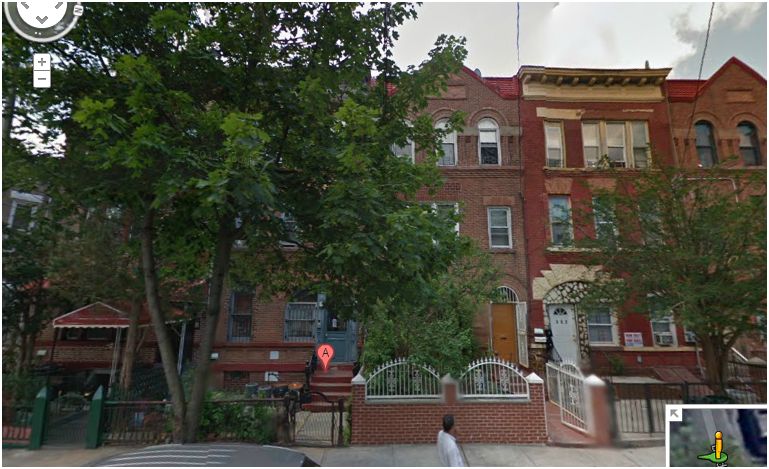
Here’s a picture of the row of brownstones mentioned in that paragraph:

306 Bradford

306 Bradford

I’ve emailed the New York Landmarks Conservancy, which is the organization that worked on the projects mentioned in the article.  I’m hoping they will be able to tell me more about the projects, the buildings and potentially my great-great-grandfather’s legacy as an architect.


Enhanced by Zemanta