Ancestry.com

How to… Get Organized with Researching My Family Tree

I’ve been away for a little while – been incredibly busy with a major work project, which included a lot of hours and travel.  Left me too exhausted and with too little time to spend on researching my family tree.  However, in May, I came across a blog post that inspired me to spend some time organizing.  Michele Simmons Lewis on her blog Ancestoring describes an Excel trick for working with the data in her Ancestry.com family tree.  At the end, it produces a spreadsheet with a list of all your ancestors, along with their birth and death dates/places.  Part of the beauty of the list is the list of names will contain a hyperlink to the individual profiles on Ancestry.com.  Here’s an example of what my list looks like:


My Family List in Excel

My Family List in Excel


Then I took the spreadsheet a few steps further – in part because I’m a complete Excel geek and because I like to use data to solve problems.  My next step, I added some extra columns:

Columns in My Spreadsheet

Columns in My Spreadsheet


  • Relationship (to me)
  • Side of the Family (Maternal, Paternal and N/A).  N/A is for my siblings, their spouses, children, etc. who don’t belong to actually one side of the family or the other.
  • Copies of Citations/Docs Downloaded.  (I’ll get more into this below.)
  • File location (for the MRIN/Marriage Record Identification Number, which I use for organizing my computer file folders)

In addition to the columns, I do a couple of other things to the data to make it easier to work with:

  1. Create a table for the range of data.  Excel behaves differently when working with data within a table that makes it easier to work with, especially when the data is very similar and when working with formulas.  To do this, highlight all the rows and columns of data in the spreadsheet.   On the Home tab, select Format as Table, then select the table format that you want/like.  I prefer a table that has alternating colors for the lines because I find that easier to read.
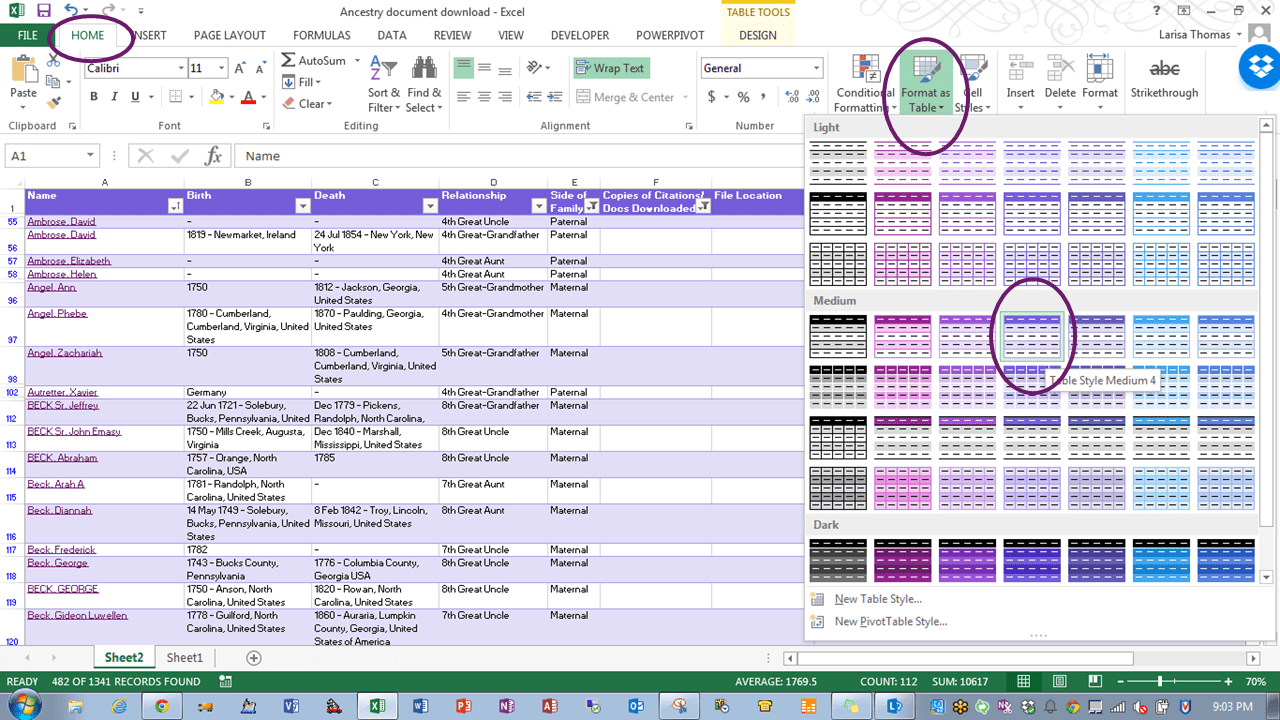
Formatting a Table

Formatting a Table

  1. Then I add a Filter to the column headers.  Highlight the row of headers, and select Filter on the Data tab.  Once the filter is set, you can click on any of the down arrows next to a column header to:
  • Sort by that column
  • Filter by certain data, such as a surname, and hide all the other rows of data.
Filters in Excel

Filters in Excel

Once I had the data formatted the way I wanted it, I was ready to get to work.  Using the hyperlinked name for each member of my family tree, I noted their relationship to me (concentrating only on direct ancestors and their siblings – I bypassed any cousins x times removed) and what side of the family they fell on.  This is easy in the Ancestry.com individual profile, as the relationship is noted in the header information.
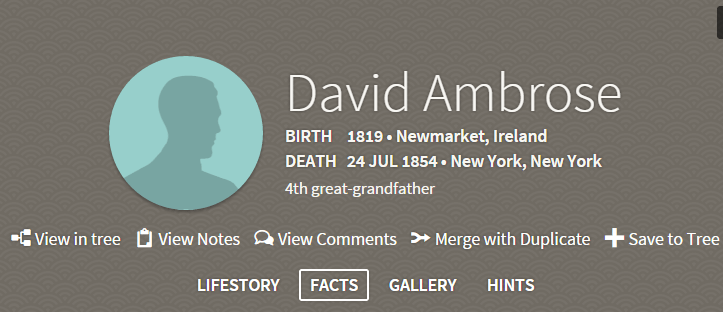
Ancestry Profile Header

Ancestry Profile Header

But the main purpose of this list is to keep track of downloading copies of the records attached to my ancestors’ profiles to my computer to retain my own digital copy of all their records.  I’m still working my way through this, but I’ve got a good head start.  Once I’ve download the attached records of a particular profile, I mark the row as “Complete” under the column: Copies of Citations/Docs Downloaded.  I also save a .pdf of the citation page from Ancestry.com for each record, including any index citations, in the ancestor profile.  I then put the path for the file folder on my computer in the last column so that I know where to find these files later.

Download and File Location Columns

Download and File Location Columns

The next trick I use in Excel is Conditional Formatting.  Whenever I enter the word “Complete” in the Download column, it will highlight the row in green so I can easily see which ancestors I’ve completed downloading the documents for.  If the ancestor doesn’t have any source citations in their profile, I mark the column as “None”.  Any marked with “None” get highlighted in red.

Conditional Formatting

Conditional Formatting

To use Conditional Formatting to highlight a whole row, based on the contents of a single cell:

  • Highlight the row of data.
  • Select Conditional Formatting from the Home tab.
  • Select New Rule
  • In the New Formatting Rule dialog box, select “Use a formula to determine which cells to format”.
  • Enter the formula entering an equal sign, click on the cell that will contain the data you want to base the formatting on.  In this case, I select the cell F59 for the Download column for row 59.  This is where I will note “Complete” or “None”.  Enter another equal sign, then the text (in quotes) that you will base the formatting on, in this case, “Complete”.
  • Click on the Format… button to select the formatting you want applied to the row, such as fill, font color and border.
  • Click OK.
  • Repeat the process for “None”.
  • Click OK to exit out of the Conditional Formatting dialog box.
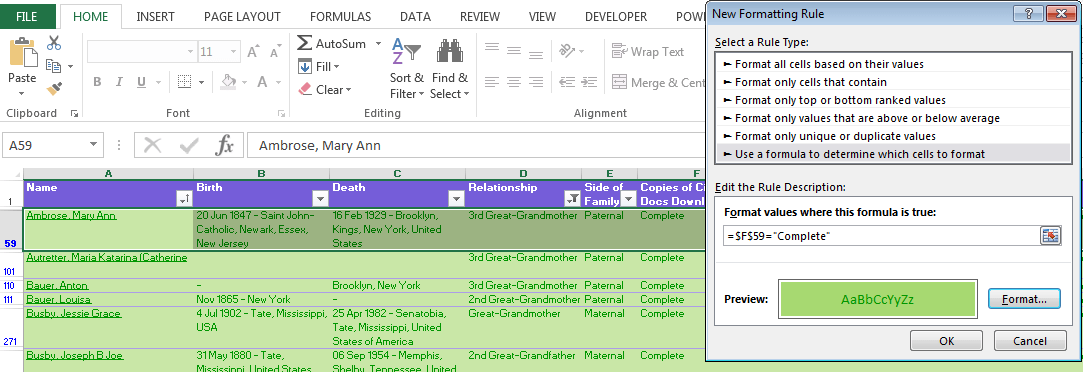
Conditional Formatting Rules

Conditional Formatting Rules

  • Select the Format Painter tool and copy the formatting to all rows in the spreadsheet.
Format Painter Tool

Format Painter Tool

Now that the spreadsheet is formatted the way I wanted, I worked my way through my family tree, surname by surname, noting the relationship and side of the family.

Now I can easily produce to do lists for research and downloading records for parts of my family tree by filtering the list based on surname, relationship type, side of the family, etc., depending on what part of my family tree I want to concentrate on.

And in the habit of playing with data, I also created some fun tables of summary information at the bottom of my spreadsheet, using some easy Countif formulas:

Counts by Side of the Family:
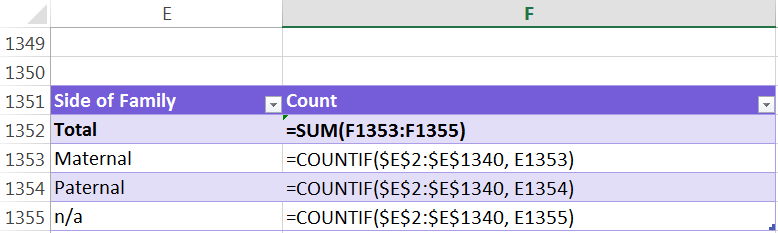
Count by Side of the Family

Count by Side of the Family

For example, to count the Maternal line, the formula is =countif(Range of Data, Cell with the word Maternal in it).  The formula will count all cells that contain the matching word from the data table.
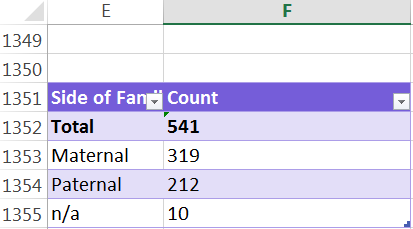
Count by Side of Family Results

Count by Side of Family Results


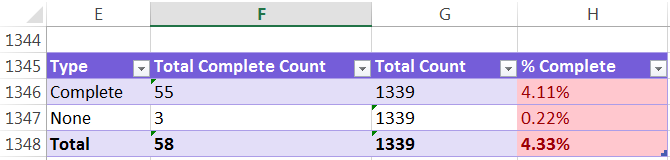
Count by Complete Downloads

Count by Complete Download

Count by Complete Download

For example, to count the Complete Download, the formula is =countif(Range of Data, “Complete”).  The formula will count all cells that contain the word “Complete” from the data table.  Then count the total number of rows by with the CountA formula, written as: =counta(range of data).  In the last column, divide the Total Complete by the Total Count to get the percentage completed.
Count by Complete Downloads Results

Count by Complete Downloads Results


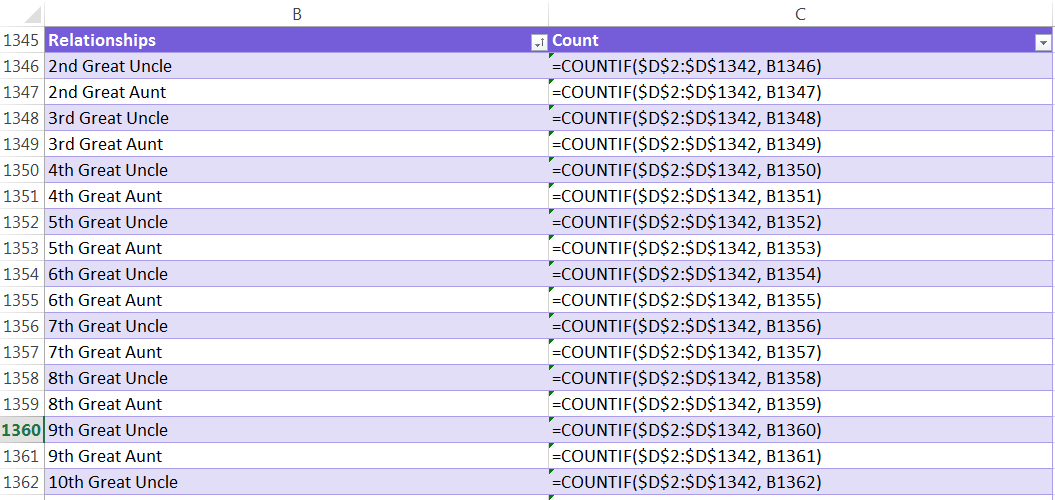
Count by Relationship Type
Count by Relationship Type

Count by Relationship Type

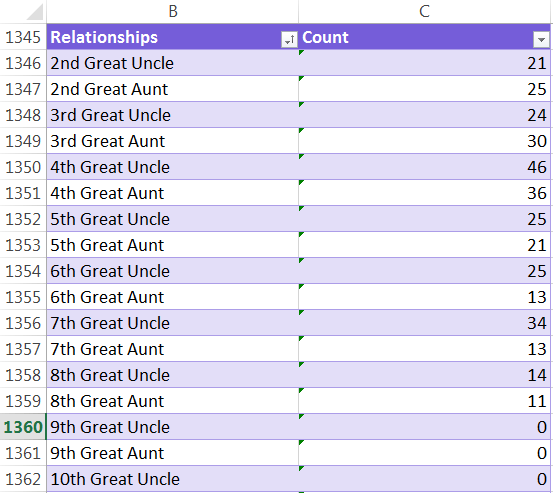
For example, to count the number of 2nd Great Uncles, the formula is =countif(Range of Data, Cell with the phrase “2nd Great Uncle” in it).  The formula will count all cells that contain the matching phrase from the data table.
Count by Relationship Type Results

Count by Relationship Type Results

A note about the “$” in some of the formulas: this hard codes the cell referenced in the formula, so that if you drag the formula down to copy it to additional cells, that part of the formula remains constant and only the non-$ numbers adjust.

So many thanks to Michele Simmons Lewis for the inspiration to riff off in order to get organized with my research.

52 Ancestors #3: Anna Henrietta Noteboom

Anna Henrietta is my 2nd great-grandmother, on my father’s maternal line.  She was an incredibly tough woman, who experienced some very difficult times her in her life, having to raise three children on her own after her husband disappeared.

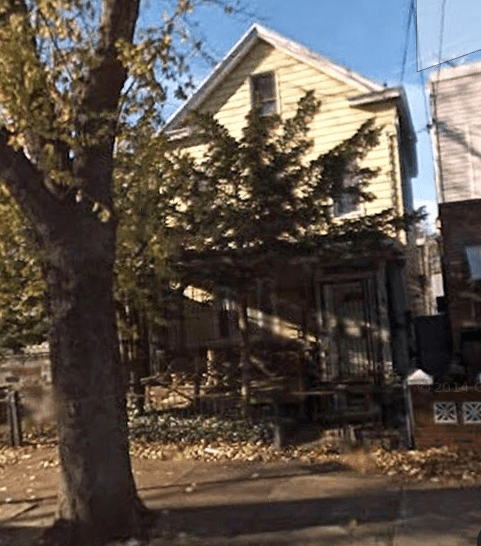
64 Van Siclen

64 Van Siclen
Image Capture: Nov 2007 © 2015 Google

Anna was born on Halloween, October 31, 1880 in Brooklyn, New York, the daughter of Walter and Christiane Noteboom.1 By 1892, she is living with her family in the 26th Ward in Brooklyn.2 The 26th Ward in Brooklyn encompassed the East New York/New Lots area of Brooklyn, and was mostly farmland. In his letter to his daughters, Gerald Thomas wrote about cows coming up to his mother’s kitchen windows.3 In 1900, Anna is a young woman, still living at home with her parents, and working as a dressmaker. Their home was located at 64 Van Siclen Avenue.4

In 1905, Anna was married to Francis Theodore Thomas and had two small children, Gerald and May.  Francis worked as a shirt ironer and Anna’s occupation was listed as housework.5  But, just a year later, Anna would be left alone, with three small children aged 5 and younger.  In August 1906, Francis left to pick up his paycheck and go for a swim at Rockaway Beach.  He was never seen again, and no sign of him was found.

Anna Noteboom Thomas, with her children, Gerald, Mae and Frank Thomas.  Year unknown.  From the collection of cousin Paul.

Anna Noteboom Thomas, with her children, Gerald, Mae and Frank Thomas. Year unknown. From the collection of cousin Paul.

Anna had been estranged from her family following her marriage to Francis.  Her father, Walter Noteboom, did not approve of him and disowned her.  Following Francis’s disappearance, Anna reconciled with her father.  Walter owned a saloon and gentleman’s hotel in Manhattan, along with at least two homes in Brooklyn.  While Anna worked as a housekeeper and laundress to earn a living, her father helped support her by paying for their winter coal and contributing to their rent.

In 1910,  they were living at 465 Belmont Avenue and shared the home with Edwin and Frances Hardcastle.  The census that year confirms that she was working as a housekeeper for others and she still claims to be married for 9 years. After her father’s death in 1913, she inherited approximately $4000.  Her brother, who was the executor of the estate, took the rent and coal money out of her share of the inheritance.6

While raising her children, Anna did what she could to make ends meet, taking in laundry, cleaning houses, and on some occasions borrowing money.  Fortunately, members of the community were willing to help out the family.  Her best friend, Bertha Happ, was a school teacher, and help Anna keep her children from being placed in a home, which was connected with a church on Wyona Street.  Schmidt, the butcher, loaned her money, and Mrs. Henning employed her to clean her home.  Gerald and May would help her by delivering laundry around the neighborhood.  When Gerald was 12, Mr. Henning offered him his first job, pumping the organ at church on Sundays.  He was paid $2.50 per month, of which he gave his mother $2 and kept $.50 for himself.  By 14, he went to work for Barrett & Nephews, a local dry cleaners.  He made $5.00 a week.  He would quit that job to work for Schmidt, the butcher, who paid him $5.oo a week to take care of his horse, but he didn’t have to pay for carfare or lunch.  Then, he went to work for Mr. Henning, at V. Henning & Sons, earning $7.00 per week.  He earned a large raise at his next job for Meyer & Lange wholesale grocers, who paid him $18 per week.  Later, Anna would meet a veteran of the Spanish American War named George Reilly, who wanted to marry her.  However, he did not get along with her oldest son, so she turned him down.7

2762 Atlantic Avenue Image Capture: June 2012 © 2015 Google

2762 Atlantic Avenue
Image Capture: June 2012 © 2015 Google

In 1915, the family had moved to 2762 Atlantic Avenue, and they had taken on a boarder.  Anna was 34 years old and working as a housekeeper.  All three children were in school.  The boarder, Alice Cokely, worked as a seamstress.  Also living in the house are Rose Sparks and her daughter Mildred. 8 Five years later, they are still living at the Atlantic Avenue home, along with Herbert Sparks and his children, Charles and Mildred, and Frank and Margaret Walsh. Anna was still a housekeeper, but now both of her older children were also working.  Gerald was a “Helper” in the Chauffeur industry, and Mae worked as a typist in the Insurance industry.  Frank was age 12 years, and still in school.  Anna was listed as a widow by this time.9

By 1925, Anna and her son, Frank, have moved to 172 Miller Avenue.  A number of families lived in the building, including the Schmidts, Burcke, Atkins, Hurleys, and two separate Speth families.  Anna was still doing housework, and Frank was then working as a printer.10

Mae and Anna Thomas, circa 1935, probably in Hempstead NY

Mae and Anna Thomas, circa 1935, probably in Hempstead NY

In 1930, Anna moved in with her oldest son and his family.  By that time, he had married Louise Schillinger, and they had two daughters, Ethel and my grandmother Marion.  In the census that year, she is listed as Elizabeth, which is strange, because her name was Anna Henrietta, and this is the only record that records her by this name.  Her occupation by then is that of a cook for a convent.11

Later, Anna would move in with her daughter Mae and her husband John F. Stamm.  In 1940, they are living at 14 Plymouth Street, Hempstead, Nassau County on Long Island. She was no longer working at that time, and was supported by her daughter and son-in-law.  John Stamm was working as a printer and earning $5000 a year.12

She lived with Mae and John for the rest of her life, dying in January 1967 at the age of 85.13

Ancestry.com. 1910 United States Federal Census [database].  Provo, UT: Ancestry.com Operations Inc., 2006.  Original data: United States of America, Bureau of the Census.  Thirteenth Census of the United States, 1910. Washington, D.C.: National Archives and Records Administration, 1910.  Census Place: Brooklyn Ward 26, Kings, New York; Serial: T624, Roll: 977, page 3B, Enumeration District: 0783, FHL microfilm: 1374990.

Ancestry.com. 1920 United States Federal Census [database].  Provo, UT: Ancestry.com Operations Inc., 2010.  Original data: United States of America, Bureau of the Census.  Fourteenth Census of the United States, 1920. Washington, D.C.: National Archives and Records Administration, 1920.  Census Place: Brooklyn Assembly District 22, Kings, New York; Serial: T625, Roll: 1179, page 9a, Enumeration District: 1409, Image: 968.

Ancestry.com. 1930 United States Federal Census [database].  Provo, UT: Ancestry.com Operations Inc., 2002.  Original data: United States of America, Bureau of the Census.  Fifteenth Census of the United States, 1930. Washington, D.C.: National Archives and Records Administration, 1930.  Census Place: Brooklyn, Kings, New York; Serial: T626, Roll: 1540, Page: 13A, Enumeration District: 0483, Image: 563, FHL microfilm: 2341275.

Ancestry.com. 1940 United States Federal Census [database].  Provo, UT: Ancestry.com Operations Inc., 2012.  Original data: United States of America, Bureau of the Census.  Sixteenth Census of the United States, 1940. Washington, D.C.: National Archives and Records Administration, 1940.  Census Place: Hempstead, Nassau, New York; Serial: T627, Roll: 2689, Page: 11a, Enumeration District: 30-178.

Ancestry.com. New York State Census, 1892 [database]. Provo, UT: Ancestry.com Operations, Inc., 2012. Original data: New York State Education Department, Office of Cultural Education. 1892 New York State Census. Albany, NY: New York State Library.

Ancestry.com. New York State Census, 1905 [database]. Provo, UT: Ancestry.com Operations, Inc., 2014. Original Data: New York State Census, 1905. Population Schedules. New York State Archives, Albany, New York. Election District: A.D. 21, E.D. 19, City: Brooklyn, County: Kings.

Ancestry.com. New York State Census, 1915 [database]. Provo, UT: Ancestry.com Operations, Inc., 2012. Original data: State Population Census Schedules, 1915. Albany, New York: New York State Archives. Election District: 44, Assembly District: 22, City: New York, County: Kings, Page: 43.

“Anna Noteboom”, Stamboom Dusseljee, Geneaologieonline, http://www.genealogieonline.nl/en/stamboom-dusseljee/I1423.php, accessed 7 January 2015.


  1. Ancestry.com. 1900 United States Federal Census [database].  Provo, UT: Ancestry.com Operations Inc., 2004.  Original data: United States of America, Bureau of the Census.  Twelfth Census of the United States, 1900. Washington, D.C.: National Archives and Records Administration, 1900.  Census Place: Brooklyn Ward 26, Kings, New York; Serial: T623, Roll: 1064, page 2A, Enumeration District: 0467, FHL microfilm: 1241064. 
  2. Ancestry.com. New York State Census, 1892
  3. Letter from Gerald Thomas to his daughters, April 1979. Photocopy in collection of author. Original location unknown. 
  4. Ancestry.com. 1900 United States Federal Census
  5. Ancestry.com. New York State Census, 1905. 
  6. Letter from Gerald Thomas.
    Ancestry.com. 1910 United States Federal Census. 
  7. Letter from Gerald Thomas. 
  8. Ancestry.com. New York State Census, 1915. 
  9. Ancestry.com. 1920 United States Federal Census. 
  10. Ancestry.com. New York State Census, 1925
  11. Ancestry.com. 1930 United States Federal Census. 
  12. Ancestry.com. 1940 United States Federal Census. 
  13. Letter from Gerald Thomas. 

52 Ancestors #2: Francis Theodore Thomas

Francis and Anna Thomas

Francis and Anna Thomas, from the collection of 2nd cousin 1x removed Paul, posted to Ancestry.com

I’ve written about Francis Theodore Thomas in the past – see “The Missing Thomas” -but I have chosen him again because I’ve learned more about him since the last post, largely in part because I connected with my 2nd cousin, 1x removed, Paul.  He had some photos and a letter from my great-grandfather, Gerald Thomas, that filled in some of the details about Francis Theodore Thomas.

Francis was born in circa 18811, the son of William Thomas and Emma J. Fredericks.  He had four older siblings: Kate, William, May and Maud.2


172 Miller Avenue, Brooklyn Image capture: Oct 2014, © Google

172 Miller Avenue, Brooklyn
Image capture: Oct 2014, © Google

In 1905, he was living at 172 Miller Avenue with his wife Anna and his oldest two children, Gerald [age 3] and May [age 2].  There were six other families living in the building, which stands the block of Miller Avenue between Fulton Street and Atlantic Avenue.  He was working as a shirt ironer, and at 24 years old, was supporting his family of four.3

According to the letter my great-grandfather wrote to my grandmother and her sister, Francis met my 2nd great-grandmother through her brother, Walter Noteboom, Jr.  He was an orphan by the time they met, and “she felt sorry for him”.  They were married in 1901 against her father’s wishes, and she became estranged from her family for several years as a result.4

Snippet from letter - Anna and Frank marry

Snippet from letter – Anna and Frank marry

When things happened…

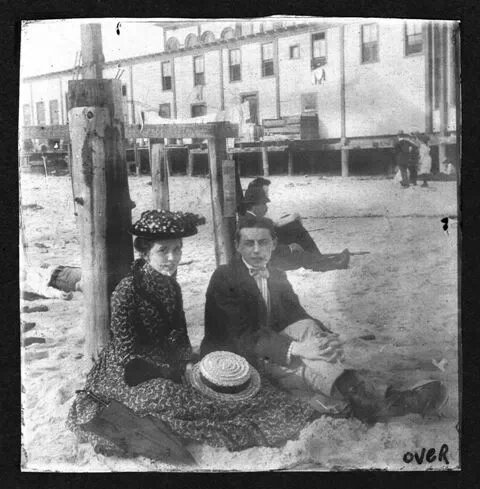
Anna Noteboom and Francis Thomas at Rockaway Beach

Anna Noteboom and Francis Thomas at Rockaway Beach

My 2nd great-grandmother Anna always referred to 1906 as the time when things happened.  In August 1906, Francis went to Rockaway Beach for a swim and never came home.  No body was every found, nor were any of his belongings.  He went to get his paycheck, and then to the beach.  After things happened, the family didn’t talk about it much and Anna was left to raise three children, ages 5 and under, on her own.  She borrowed money from the local butcher, and took to cleaning houses and washing clothes to make ends meet.  It was only after Francis disappeared did she reconcile with her father.5

Not much is known about Francis’s family.  Gerald writes in the letter that he had a brother William, who was murdered on the Brooklyn waterfront.  His sister Kate married Thomas Bouse, and Mae married Jack Gardner.  His mother’s maiden name was Fredericks, and she had a sister who married a Captain Hall, who served during the U.S. Civil War.  He is buried at Cypress Hills Cemetery in Brooklyn.  His father is said to have ancestors who were Pennsylvania Quakers.6


  1. Ancestry.com. New York, State Census, 1905 [database on-line]. Provo, UT, USA: Ancestry.com Operations, Inc., 2014.  Original data: New York, State Census, 1905. Population Schedules . New York State Archives, Albany, New York.  State Population Census Schedules, 1905; Election District: A.D. 21 E.D. 19; City: Brooklyn; County: Kings, Page 48. 
  2. Ancestry.com.  Devine-Thomas Family Tree. Posted by pxdbrewer. 
  3.  Ancestry.com. New York, State Census, 1905. 
  4. Letter from Gerald Thomas to Marion Reilly and Ethel Furia, photocopy in my collection, original unknown, April-May 1979. 
  5. ibid. 
  6. ibid. 

52 Ancestors #1: The Life of Walter Noteboom

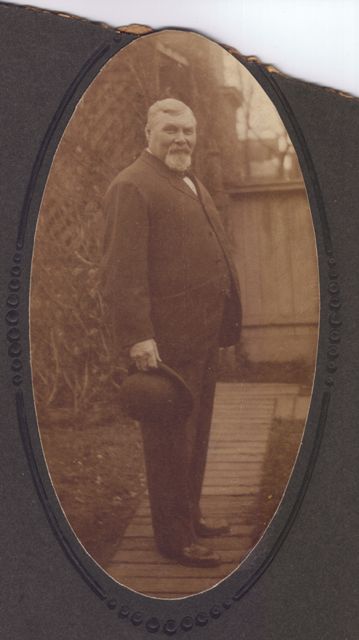
Walter Noteboom, c. 1905, probably in Brooklyn, NY

Walter Noteboom, c. 1905, probably in Brooklyn, NY

This is the life of Walter Noteboom, a Dutch man who immigrated to the United States in 1870, and became quite successful as a saloon and hotel owner in Manhattan. Born in Winschoten, Netherlands in 1844, Walter made his way to the United States, eventually marrying three times and fathering eight children.

The Childhood of Walter Noteboom

Walter (born Wolter) Noteboom was born at six o’clock in the evening on November 12, 1844 in Winschoten, Groningen, Netherlands to Wolter Noteboom and Hendrina Harms de Weert.

Wolter Noteboom Birth Registration

Wolter Noteboom Birth Registration

From the register of his birth in Winschoten:

In the year one thousand eight hundred and forty-four, the thirteenth of the month of November for our undersigned Councillor official of the Civil State of the municipality Winschoten, District Winschoten, Groningen Province, appeared Wolter Noteboom, thirty-nine years old, of professional Dyer and [Squeezer] and Calenderer, residing Winschoten, which stated that on the twelfth of the month of November in the year one thousand eight hundred and forty-four, in the evening at six o’clock, within the municipality of Winschoten, a child is born of the male sex, to which the first name Wolter shall be given; of which child’s Mother is, Henderina Weerdt, and Father Wolter Noteboom said spouses.

And this declaration and statement done in the presence of William Guits Strootman, aged sixty years, occupation Hatter, residing in Winschoten, and Frederik Jan Hockzema, aged fifty-one years, a professional Book Seller, residing in Winschoten, as to do so elected witnesses selected by the party.

Of which this deed and immediately enrolled in the [twice] in the birth registry of this town, and this deed after them was read to witnesses appearing and signed by them beside us.1

Walter was ninth of eleven children. His father, Wolter, was a fabric manufacturer and dyer who apparently died young of indigo poisoning, on November 19, 1852, when Walter was only eight years old. Wolter, the elder, born in Emden, Germany on May 31, 1805, moved to Winschoten circa 1843 to ply his trade in the garment industry.2 His mother, Hendrina was born on February 11, 1807 in Emden, and also worked in the garment industry as a seamstress. She lived until November 28, 1884 when she died in Winschoten.3

Winschoten, Groningen, Netherlands

"Dommersen Winschoten 1889". Licensed under Public Domain via Wikimedia Commons - http://commons.wikimedia.org/wiki/File:Dommersen_Winschoten_1889.jpg#mediaviewer/File:Dommersen_Winschoten_1889.jpg

“Dommersen Winschoten 1889”. Licensed under Public Domain via Wikimedia Commons

During his childhood, Winschoten was a small town, with a population numbering only about 4000-5000 people. By the time he immigrated to the United States, the town held 5500 people. Nicknamed the “Mill City”, Winschoten had thirteen mills at one time. The inhabitants are jokingly call Tellerlikkers (plate lickers) for the propensity to eat voraciously and then lick the plate clean.4

The patron saint of Winschoten is St. Vitus, who was persecuted and died a martyr in 303 A.D. under co-Emperors Diocletian and Maximian. He is considered one of the Fourteen Holy Helpers, saints who come to the aid of the ill. Vitus is the patron saint of dancers, actors and entertainers, epileptics, dogs, oversleeping and storms, among others.5

Winschoten was home to the second largest community of Jews in the Netherlands. During the Second World War, however, it became a transit depot for the movement of European Jews to Germany’s concentration camps. Winschoten was liberated in 1945 by Belgian, Canadian and Polish troops. At the end of the war, only 20 of Winschoten’s Jews had survived.6

Several cultural landmarks have survived the ages and still stand in Winschoten today. The Dutch Reform Church, built on the Marktplein, dates from the 13th century. The Synagogue dates from 1854. Three of the thirteen mills still stand: Molen Berg, built in 1854; Dijkstra Molen, built in 1862; and Molen Edens, built in 1763. 7

Molen Berg was innovative for the times because the sailes were built with moveable blades (similar to mini-blinds). The Dijkstra Molen was sold in 1953 to the local government and restored in 1982-1983. Molen Edens is the oldest mill in the entire province of Groningen.
Many of the inhabitants speak English and German in addition to Dutch, while many older generations speak a local dialect called Gronings, which is influenced by the Hebrew and Yiddish of the Jewish residents.8

His Early Years in the United States

Walter emigrated from the Netherlands to the United States on June 28, 1870, arriving in Brooklyn, New York. When he first arrived, he was a sailor, like several of his brothers, but by the mid-1870s, he was working in the hotel and bar industry. He became a naturalized citizen on 20 October 18839 He married Beta Nüllmeyer on November 11, 1876. Beta was born in Bremen, Germany sometime in 1850. She died in 1878, possibly during childbirth. He next married Beta’s sister, Christiane Nüllmeyer on September 21, 1879 in Brooklyn. Christiane was born on June 27, 1852 in Bremen, Germany. She immigrated to the United States in 1877. By 1900 Christiane had given birth to eight children, of whom five had survived. He married his third, and final, wife Katherine A. Dulk (known as “Mama Kate”) on June 25, 1901 in Brooklyn. Kate was born in New York on February 9, 1862 and had a twin brother Michael.

How He Made a Living

When Walter first came to the United States, he worked briefly as a sailor, but eventually purchased a saloon. According to many documents, he started his career in the hotel and bar business as a porter in Manhattan. As early as May 1882, he was working as a porter, which continued until as late as 1889. By 1892, he had purchased his bar at 143 Park Row in Manhattan. He continued as a liquor dealer until 1901, when he expanded his business to include lodgings at 450 Pearl Street in New York.10

His Children

Walter had five children, who survived to adulthood:

Anna Henrietta “Annie” Noteboom

Walter’s oldest child, Anna Henrietta “Annie” Noteboom, was born on October 31, 1880 in Brooklyn, New York. By 1900 she had found work as a dressmaker. She married Francis Theodore Thomas, who her father had forbidden her to marry because he was an orphan with no prospects. They had three children: Gerald Francis Thomas, Mae D. Thomas and Frank Thomas. Gerald was born on March 10, 1902 in Manhattan. Mae was born in 1903 and Frank was born in 1908. Sometime before 1910, her husband had disappeared. He had gone to Rockaway Beach for a swim and was never heard from or seen again. Anna died in 1958 at the age of 78.11

Dorothea A. “Dora” Noteboom

Dorothea was born on September 5, 1882 in Brooklyn, New York. In 1910, she was working as a lace house clerk and by 1910 she was working as a typist at McMillan Publishing. She married Richard Krankenberg. She died on June 20, 1968 at the age of 85.12

Johanna Christina “Honey” Noteboom

Johanna was born on December 7, 1884 in Brooklyn, New York. By 1905, she was working as a wholesale drug clerk in Brooklyn. She married Harry Wistar Weymer on June 12, 1907 in Brooklyn. Together, they had four sons, two of whom died at tragically young ages. Harry Wistar Weymer Jr. was born on July 23, 1908 in Brooklyn. Walter Stanley Weymer as born on March 2, 1910 in Brooklyn and died at the age of 8 on October 20, 1918. John Spencer Weymer was born on August 24, 1911 and died at the age of 15 on March 12, 1927. Horace Jerome Weymer was born on July 26, 1923.13

Walter Noteboom, Jr.

Walter Jr. was born on November 5, 1885 in Brooklyn, New York. Beginning circa 1904, Walter began work as a photo engrave, electrotyper or printer. He married Dorothy Mann in June 1927, but they do not appear to have had any children. He eventually moved back to Brooklyn sometime before 1920. He died in 1955 and is buried in the Evergreens Cemetery in Brooklyn.14

Geraldine Meta “Dina” Noteboom

Geraldine was born on November 7, 1888 in Brooklyn, New York. By 1910, she worked as a clerk in a sporting goods store in Brooklyn, New York. On April 8, 1917, she married James Francis Clark. They had two children, a son named James Francis and a daughter named Helena Dorothea. James died on July 15, 1963 and Geraldine followed six years later on December 23, 1969.15

There were possibly three other children during these years, according to the 1900 Federal Census. Based on the spacing of the birthdates of the three surviving children, they either came before the birth of Anna, the eldest child, possibly in between Dorothea and Johanna, possibly in between Walter and Geraldine, or after Geraldine. Christiane was deceased shortly after the 1900 Census was enumerated, possibly during childbirth. Since that is 12 years after the birth of the youngest surviving child, the likelihood that there were children in between Geraldine’s birth and Christiane’s death that did not survive. No official record of these births has been located other than the reference in the 1900 Census.16

His Death

Walter passed away on 14 December 1913 in Brooklyn, New York. He was 69 years old at the time of his death. In his obituary, several fraternal and club memberships were listed, including
the Eastern Parkway Fishing Club, the Odd Fellows, Alleghany Lodge, Knights of Pythias and Tyrian Lodge, Free and Accepted Masons.17


  1. “Wolter Noteboom”, BS Geboorte, Groninger Archieven, Geboorteregister 1844, Bron: Boek, Periode: 1844, Record No. 112, Record date: 13 November 1844, WieWasWie, https://www.wiewaswie.nl/en/search/search/record-details/a2apersonid/371157245/srcid/19034961/oid/31, accessed 7 January 2015. 
  2. “Wolter Noteboom”, Stamboom Dusseljee, Geneaologieonline, http://www.genealogieonline.nl/en/stamboom-dusseljee/I217.php, accessed 7 January 2015. 
  3. “Hedrina Harms de Weert”, Stamboom Dusseljee, Geneaologieonline, http://www.genealogieonline.nl/en/stamboom-dusseljee/I230.php, accessed 7 January 2015. 
  4. “Winschoten”, Wikipedia, http://en.wikipedia.org/wiki/Winschoten, modified 18 December 2014, accessed 7 January 2015. 
  5. “Vitus”, Wikipedia, http://en.wikipedia.org/wiki/Vitus, modified 20 December 2014, accessed 7 January 2015. 
  6. “Winschoten”, Wikipedia. 
  7. ibid. 
  8. ibid. 
  9. “Wolter Noteboom”, GenealogieOnline.
    Ancestry.com. New York Passenger Lists, 1820-1957, database. Provo, UT: Ancestry.com Operations, Inc., 2010. Original data: Passenger Lists of Vessels Arriving in New York, New York, 1820-1897 Washington, D.C.: National Archives and Records Administration, Microfilm Serial: T715, Roll: 2198, Page 25, Line 4, Year 1913.
    Ancestry.com U.S. Naturalization Record Indexes, 1791-1992 (Indexed in World Archives Project), database. Provo, UT: Ancestry.com Operations, Inc., 2010. Original data: Selected U.S. Naturalization Records. Washington, D.C.: National Archives and Records Administration, Microfilm Serial: M1674, Roll: 195. 
  10. Ancestry.com. U.S. City Directories, 1821-1989, database. Provo, UT: Ancestry.com Operations, Inc., 2011. Original data: Variety of directories from Manhattan and Brooklyn, for the years 1882, 1887, 1888, 1889, 1892, 1894, 1897, 1901, 1902, 1903, 1904, 1905, 1907, 1910, 1912. 
  11. Letter from Gerald Thomas to his daughters, April 1979. Photocopy in collection of author. Original location unknown.
    “Anna Noteboom”, Stamboom Dusseljee, Geneaologieonline, http://www.genealogieonline.nl/en/stamboom-dusseljee/I1423.php, accessed 7 January 2015.
    Ancestry.com. 1900 United States Federal Census database. Provo, UT, USA: Ancestry.com Operations Inc, 2004. Original data: United States of America, Bureau of the Census. Twelfth Census of the United States, 1900. Washington, D.C.: National Archives and Records Administration, 1900. Year: 1900; Census Place: Brooklyn Ward 26, Kings, New York; Roll: 1064; Page: 2A; Enumeration District: 0467; FHL microfilm: 1241064. 
  12. Ancestry.com, Social Security Death Index, 1935-2014, database. Provo, UT, USA: Ancestry.com Operations Inc, 2011. Original data: Social Security Administration. Social Security Death Index, Master File. Social Security Administration. Number: 088-05-6009; Issue State: New York; Issue Date: Before 1951.
    Ancestry.com. 1930 United States Federal Census database. Provo, UT, USA: Ancestry.com Operations Inc, 2002. Original data: United States of America, Bureau of the Census. Fifteenth Census of the United States, 1930. Washington, D.C.: National Archives and Records Administration, 1930. Year: 1930; Census Place: Brooklyn, Kings, New York; Roll: 1540; Page: 10A; Enumeration District: 0481; Image: 467.0; FHL microfilm: 2341275.
    “Dorothea Noteboom”, Stamboom Dusseljee, Geneaologieonline, http://www.genealogieonline.nl/en/stamboom-dusseljee/I1307.php, accessed 7 January 2015. 
  13. Letter from Gerald Thomas.
    Ancestry.com. 1900 United States Federal Census.
    “Johanna Christina Noteboom”, Stamboom Dusseljee, Geneaologieonline, http://www.genealogieonline.nl/en/stamboom-dusseljee/I1424.php, accessed 7 January 2015. 
  14. “Walter Noteboom”, Stamboom Dusseljee, Geneaologieonline, http://www.genealogieonline.nl/en/stamboom-dusseljee/I1305.php, accessed 7 January 2015.
    Ancestry.com. 1900 United States Federal Census
  15. Ancestry.com. 1900 United States Federal Census.
    “Geraldine Meta Noteboom”, Stamboom Dusseljee, Geneaologieonline, http://www.genealogieonline.nl/en/stamboom-dusseljee/I1306.php, accessed 7 January 2015.
    Ancestry.com. New York, New York, Marriage Index 1866-1937, database. Provo, UT, USA: Ancestry.com Operations, Inc., 2014. Original data: Index to New York City Marriages, 1866-1937. Indices prepared by the Italian Genealogical Group and the German Genealogy Group, and used with permission of the New York City Department of Records/Municipal Archives. 
  16. Ancestry.com. 1900 United States Federal Census
  17. The Brooklyn Daily Eagle, New York, Tuesday, December 16, 1913, Page 3, Column 4.”Walter Noteboom Obituary”. Newspapers.com, http://www.newspapers.com/image/54328490/

Xaver Schillinger’s Death Certificate

I found a reference to Xaver Schillinger’s death certificate in the New York, New York, Death Index, 1862-1948 on Ancestry.com.  The reference gave me the certificate number, which I then obtained from the NYC Municipal Archives.  It arrived in the mail yesterday!

Xaver Schillinger Death Certificate

Xaver Schillinger Death Certificate

So let’s take a look at what we can learn from his death certificate.

1.  Xaver Schillinger died at Brooklyn Hospital. (The Brooklyn Hospital is located at 121 DeKalb Avenue in Brooklyn.

Xaver Schillinger Death Certificate - Annotation 1

Xaver Schillinger Death Certificate Annotation 1

2. The death certificate confirms, not only the date of death, his sex and race, but it also confirms that his wife Catherine predeceased him.  This allows me to look for her death records sometime between when she last shows up in a census (1900) and his year of death (1923).

Xaver Schillinger Death Certificate Annotation 2

Xaver Schillinger Death Certificate Annotation 2

3.  I have his approximate year of birth as 1836.  His death certificate lists his age as 87.  Since he died in 1923 (1923-87=1836), his death certificate agrees with what I know to be his birth year.  Unfortunately, it does not list the months or day, nor does it list his specific birth date, so I cannot confirm his birth beyond the year.

Xaver Schillinger Death Certificate Annotation 3

Xaver Schillinger Death Certificate Annotation 3

4. The death certificates agrees that he is an immigrant from Germany and it lists his number of years in the United States as 62.  This would place his year of immigration as 1861.  My previous records had his immigration occurring in 1860, with his enlistment in the US Army by March 1861.  So his death certificate is consistent (within 1 year) of the information I already had on record.  Taking in to account that the information on the death certificate is being reported by a 3rd party (his daughter Catherine), who was not alive at the time of his immigration, I am satisfied that the record is consistent with other documentation.

Xaver Schillinger Death Certificate Annotation 4

Xaver Schillinger Death Certificate Annotation 4

5. The death certificated gives me his parents’ names!  This is probably the most exciting piece of information on the document.  I had his parents listed as “Franz Xaver Schillinger” and “Franziska Stockel”.  Now these names are close, but I never had documentation of these names – just information from other people’s family trees.  This is the first official record that I’ve come across with their names on it.  It’s important to note that his father is not listed as Franz, but as Xaver.  The one issue I’ve had is that I have found no documentation for this Xaver to have a first name of Franz either, though that is how I’ve come across him being recorded in others’ trees.  Also, his mother’s last name is spelled with an “a” on the death certificate, not an “o”.  These are great leads for tracking down more information about the family in Germany, as neither of his parents appear to have immigrated to the United States.

Xaver Schillinger Death Certificate Annotation 5

Xaver Schillinger Death Certificate Annotation 5

6. His residence at his time of death was 148 Logan Street.  This is consistent with my other records.  In the 1920 census, he is listed as living with his daughter Catherine Fausner (who is also the reporting party on the death certificate) at the Logan Street address.  This information helps to confirm that I have the death certificate for the correct person.

Xaver Schillinger Death Certificate Annotation 6

Xaver Schillinger Death Certificate Annotation 6

7.  Xaver Schillinger was in the hospital from 2 Oct 1923 until 6 Oct 1923, when he passed away at 12:30pm.  He was attended by Dr. T.M. Dudley.  His cause of death is: “right strangulated femoral hernia.  Left sliding inguinal hernia. Hernioplasty.”  The duration of the condition is listed as “many” years.  A contributing/secondary cause of death is listed as “broncho pneumonia“.  So it would appear that Xaver went to the hospital to have to hernias repaired, one of which, at least, is a very serious condition.  The right strangulated femoral hernia can cause the blood to be cut off to the bowels and result in necrosis – which is life threatening.  His stay in the hospital was complicated by a bout of pneumonia, which was even made more dangerous because of his age.

Xaver Schillinger Death Certificate Annotation 7

Xaver Schillinger Death Certificate Annotation 7

8. He is buried at Holy Trinity Cemetery.  I had found a previous reference to an Xaver Schillinger being buried in Trinity Cemetery, but had no confirmation which Trinity Cemetery or that it was my Xaver Schillinger.  The death certificate is consistent with the burial record I found, which also includes the plot information (Block 5, Row 6).  Most Holy Trinity Cemetery is located next to The Evergreens Cemetery on Central Avenue in Brooklyn.

Xaver Schillinger Death Certificate Annotation 8

Xaver Schillinger Death Certificate Annotation 8

Enhanced by Zemanta