Writing & Education

In 1814 we took a little trip…

In 1959, Johnny Horton earned a number one hit on the Billboard Charts for the song The Battle of New Orleans.  Written by Jimmy Driftwood, it commemorates the victory of the United States over the British Army at the end of the War of 1812.1

Today, January 8, 2015, commemorates the 200th anniversary of the conclusion of the battle, fought from December 23, 1814 to January 8, 1815.  It was the last important battle of the War of 1812, occurring after the Treaty of Ghent was signed on December 24, 1814 (but before the treaty was ratified by both governments in February 1815).2

The Battle of New OrleansAll of this is to set the background of a song that played a significant role in my childhood.  When my father was overseas in the US Navy, he picked up several LPs, including Johnny Horton’s album. It was made from a semi-translucent red plastic, and probably was meant to last more that a few dozen plays. My family defied physics and played that album over and over and over again!

It was a favorite of ours, mostly because the tunes on the album were catchy, and some were slightly silly, and all were easy to remember the lyrics and sing along to (though no one really wants to listen to a Reilly sing). In some ways, this song was one of the theme songs of my life, and had a funny way of popping up again and again.

The first time the song showed up unexpectedly I was a junior in college at NYU, studying Journalism.  I was taking a class taught by Mitchell Stephens about the History of American Journalism.  We were discussing how news traveled during the War of 1812, and the popular belief that the Battle of New Orleans took place after the treaty was signed because the news had not reached the combatants in time to stop the battle.  Out of the blue, Professor Stephens asked if anyone was familiar with the song The Battle of New Orleans.  Without really thinking, I raised my hand, surprised at the question.  He then asked me to sing it!  I wasn’t about to embarrass myself by singing in front of the entire class, but I did recite the lyrics (see box).  I also offered to bring in my Johnny Horton CD to the next class to play the song for the class.  (Yes – I had bought a CD of the album once I had gone off to college.  It helped deal with the homesickness of being almost 3000 miles away from home.)

The second time the song caught me by surprise was the night I first introduced the man who was to become my husband to my family.  It was the summer before my senior year of college, and I brought him home for dinner at the end of the summer before I returned to college for my final year.  I don’t remember now how it came up in conversation, but all of a sudden my entire family simultaneously broke out singing the song, including my mom!  I remember thinking, “Oh my, he’s never going to want to go out with me again!”.  Fortunately, he’s a good sport, and thought it was funny, if a little weird.

To hear the song for yourself, view this YouTube video:


  1.  The Battle of New Orleans, Wikipedia: http://en.wikipedia.org/wiki/The_Battle_of_New_Orleans, Modified 18 Dec 2014, Accessed 5 Jan 2015. 
  2. Battle of New Orleans, Wikipedia:  http://en.wikipedia.org/wiki/Battle_of_New_Orleans, Modified 2 Jan 2015, Accessed 5 Jan 2015. 

52 Ancestors #1: The Life of Walter Noteboom

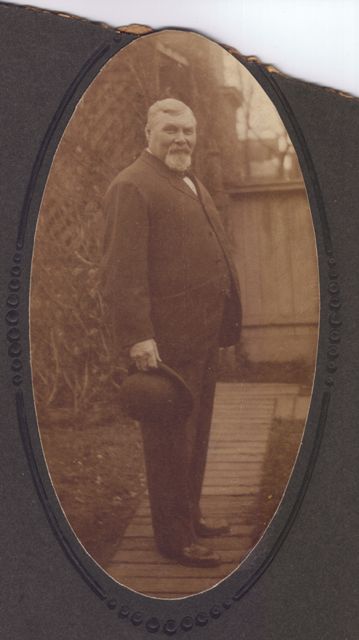
Walter Noteboom, c. 1905, probably in Brooklyn, NY

Walter Noteboom, c. 1905, probably in Brooklyn, NY

This is the life of Walter Noteboom, a Dutch man who immigrated to the United States in 1870, and became quite successful as a saloon and hotel owner in Manhattan. Born in Winschoten, Netherlands in 1844, Walter made his way to the United States, eventually marrying three times and fathering eight children.

The Childhood of Walter Noteboom

Walter (born Wolter) Noteboom was born at six o’clock in the evening on November 12, 1844 in Winschoten, Groningen, Netherlands to Wolter Noteboom and Hendrina Harms de Weert.

Wolter Noteboom Birth Registration

Wolter Noteboom Birth Registration

From the register of his birth in Winschoten:

In the year one thousand eight hundred and forty-four, the thirteenth of the month of November for our undersigned Councillor official of the Civil State of the municipality Winschoten, District Winschoten, Groningen Province, appeared Wolter Noteboom, thirty-nine years old, of professional Dyer and [Squeezer] and Calenderer, residing Winschoten, which stated that on the twelfth of the month of November in the year one thousand eight hundred and forty-four, in the evening at six o’clock, within the municipality of Winschoten, a child is born of the male sex, to which the first name Wolter shall be given; of which child’s Mother is, Henderina Weerdt, and Father Wolter Noteboom said spouses.

And this declaration and statement done in the presence of William Guits Strootman, aged sixty years, occupation Hatter, residing in Winschoten, and Frederik Jan Hockzema, aged fifty-one years, a professional Book Seller, residing in Winschoten, as to do so elected witnesses selected by the party.

Of which this deed and immediately enrolled in the [twice] in the birth registry of this town, and this deed after them was read to witnesses appearing and signed by them beside us.1

Walter was ninth of eleven children. His father, Wolter, was a fabric manufacturer and dyer who apparently died young of indigo poisoning, on November 19, 1852, when Walter was only eight years old. Wolter, the elder, born in Emden, Germany on May 31, 1805, moved to Winschoten circa 1843 to ply his trade in the garment industry.2 His mother, Hendrina was born on February 11, 1807 in Emden, and also worked in the garment industry as a seamstress. She lived until November 28, 1884 when she died in Winschoten.3

Winschoten, Groningen, Netherlands

"Dommersen Winschoten 1889". Licensed under Public Domain via Wikimedia Commons - http://commons.wikimedia.org/wiki/File:Dommersen_Winschoten_1889.jpg#mediaviewer/File:Dommersen_Winschoten_1889.jpg

“Dommersen Winschoten 1889”. Licensed under Public Domain via Wikimedia Commons

During his childhood, Winschoten was a small town, with a population numbering only about 4000-5000 people. By the time he immigrated to the United States, the town held 5500 people. Nicknamed the “Mill City”, Winschoten had thirteen mills at one time. The inhabitants are jokingly call Tellerlikkers (plate lickers) for the propensity to eat voraciously and then lick the plate clean.4

The patron saint of Winschoten is St. Vitus, who was persecuted and died a martyr in 303 A.D. under co-Emperors Diocletian and Maximian. He is considered one of the Fourteen Holy Helpers, saints who come to the aid of the ill. Vitus is the patron saint of dancers, actors and entertainers, epileptics, dogs, oversleeping and storms, among others.5

Winschoten was home to the second largest community of Jews in the Netherlands. During the Second World War, however, it became a transit depot for the movement of European Jews to Germany’s concentration camps. Winschoten was liberated in 1945 by Belgian, Canadian and Polish troops. At the end of the war, only 20 of Winschoten’s Jews had survived.6

Several cultural landmarks have survived the ages and still stand in Winschoten today. The Dutch Reform Church, built on the Marktplein, dates from the 13th century. The Synagogue dates from 1854. Three of the thirteen mills still stand: Molen Berg, built in 1854; Dijkstra Molen, built in 1862; and Molen Edens, built in 1763. 7

Molen Berg was innovative for the times because the sailes were built with moveable blades (similar to mini-blinds). The Dijkstra Molen was sold in 1953 to the local government and restored in 1982-1983. Molen Edens is the oldest mill in the entire province of Groningen.
Many of the inhabitants speak English and German in addition to Dutch, while many older generations speak a local dialect called Gronings, which is influenced by the Hebrew and Yiddish of the Jewish residents.8

His Early Years in the United States

Walter emigrated from the Netherlands to the United States on June 28, 1870, arriving in Brooklyn, New York. When he first arrived, he was a sailor, like several of his brothers, but by the mid-1870s, he was working in the hotel and bar industry. He became a naturalized citizen on 20 October 18839 He married Beta Nüllmeyer on November 11, 1876. Beta was born in Bremen, Germany sometime in 1850. She died in 1878, possibly during childbirth. He next married Beta’s sister, Christiane Nüllmeyer on September 21, 1879 in Brooklyn. Christiane was born on June 27, 1852 in Bremen, Germany. She immigrated to the United States in 1877. By 1900 Christiane had given birth to eight children, of whom five had survived. He married his third, and final, wife Katherine A. Dulk (known as “Mama Kate”) on June 25, 1901 in Brooklyn. Kate was born in New York on February 9, 1862 and had a twin brother Michael.

How He Made a Living

When Walter first came to the United States, he worked briefly as a sailor, but eventually purchased a saloon. According to many documents, he started his career in the hotel and bar business as a porter in Manhattan. As early as May 1882, he was working as a porter, which continued until as late as 1889. By 1892, he had purchased his bar at 143 Park Row in Manhattan. He continued as a liquor dealer until 1901, when he expanded his business to include lodgings at 450 Pearl Street in New York.10

His Children

Walter had five children, who survived to adulthood:

Anna Henrietta “Annie” Noteboom

Walter’s oldest child, Anna Henrietta “Annie” Noteboom, was born on October 31, 1880 in Brooklyn, New York. By 1900 she had found work as a dressmaker. She married Francis Theodore Thomas, who her father had forbidden her to marry because he was an orphan with no prospects. They had three children: Gerald Francis Thomas, Mae D. Thomas and Frank Thomas. Gerald was born on March 10, 1902 in Manhattan. Mae was born in 1903 and Frank was born in 1908. Sometime before 1910, her husband had disappeared. He had gone to Rockaway Beach for a swim and was never heard from or seen again. Anna died in 1958 at the age of 78.11

Dorothea A. “Dora” Noteboom

Dorothea was born on September 5, 1882 in Brooklyn, New York. In 1910, she was working as a lace house clerk and by 1910 she was working as a typist at McMillan Publishing. She married Richard Krankenberg. She died on June 20, 1968 at the age of 85.12

Johanna Christina “Honey” Noteboom

Johanna was born on December 7, 1884 in Brooklyn, New York. By 1905, she was working as a wholesale drug clerk in Brooklyn. She married Harry Wistar Weymer on June 12, 1907 in Brooklyn. Together, they had four sons, two of whom died at tragically young ages. Harry Wistar Weymer Jr. was born on July 23, 1908 in Brooklyn. Walter Stanley Weymer as born on March 2, 1910 in Brooklyn and died at the age of 8 on October 20, 1918. John Spencer Weymer was born on August 24, 1911 and died at the age of 15 on March 12, 1927. Horace Jerome Weymer was born on July 26, 1923.13

Walter Noteboom, Jr.

Walter Jr. was born on November 5, 1885 in Brooklyn, New York. Beginning circa 1904, Walter began work as a photo engrave, electrotyper or printer. He married Dorothy Mann in June 1927, but they do not appear to have had any children. He eventually moved back to Brooklyn sometime before 1920. He died in 1955 and is buried in the Evergreens Cemetery in Brooklyn.14

Geraldine Meta “Dina” Noteboom

Geraldine was born on November 7, 1888 in Brooklyn, New York. By 1910, she worked as a clerk in a sporting goods store in Brooklyn, New York. On April 8, 1917, she married James Francis Clark. They had two children, a son named James Francis and a daughter named Helena Dorothea. James died on July 15, 1963 and Geraldine followed six years later on December 23, 1969.15

There were possibly three other children during these years, according to the 1900 Federal Census. Based on the spacing of the birthdates of the three surviving children, they either came before the birth of Anna, the eldest child, possibly in between Dorothea and Johanna, possibly in between Walter and Geraldine, or after Geraldine. Christiane was deceased shortly after the 1900 Census was enumerated, possibly during childbirth. Since that is 12 years after the birth of the youngest surviving child, the likelihood that there were children in between Geraldine’s birth and Christiane’s death that did not survive. No official record of these births has been located other than the reference in the 1900 Census.16

His Death

Walter passed away on 14 December 1913 in Brooklyn, New York. He was 69 years old at the time of his death. In his obituary, several fraternal and club memberships were listed, including
the Eastern Parkway Fishing Club, the Odd Fellows, Alleghany Lodge, Knights of Pythias and Tyrian Lodge, Free and Accepted Masons.17


  1. “Wolter Noteboom”, BS Geboorte, Groninger Archieven, Geboorteregister 1844, Bron: Boek, Periode: 1844, Record No. 112, Record date: 13 November 1844, WieWasWie, https://www.wiewaswie.nl/en/search/search/record-details/a2apersonid/371157245/srcid/19034961/oid/31, accessed 7 January 2015. 
  2. “Wolter Noteboom”, Stamboom Dusseljee, Geneaologieonline, http://www.genealogieonline.nl/en/stamboom-dusseljee/I217.php, accessed 7 January 2015. 
  3. “Hedrina Harms de Weert”, Stamboom Dusseljee, Geneaologieonline, http://www.genealogieonline.nl/en/stamboom-dusseljee/I230.php, accessed 7 January 2015. 
  4. “Winschoten”, Wikipedia, http://en.wikipedia.org/wiki/Winschoten, modified 18 December 2014, accessed 7 January 2015. 
  5. “Vitus”, Wikipedia, http://en.wikipedia.org/wiki/Vitus, modified 20 December 2014, accessed 7 January 2015. 
  6. “Winschoten”, Wikipedia. 
  7. ibid. 
  8. ibid. 
  9. “Wolter Noteboom”, GenealogieOnline.
    Ancestry.com. New York Passenger Lists, 1820-1957, database. Provo, UT: Ancestry.com Operations, Inc., 2010. Original data: Passenger Lists of Vessels Arriving in New York, New York, 1820-1897 Washington, D.C.: National Archives and Records Administration, Microfilm Serial: T715, Roll: 2198, Page 25, Line 4, Year 1913.
    Ancestry.com U.S. Naturalization Record Indexes, 1791-1992 (Indexed in World Archives Project), database. Provo, UT: Ancestry.com Operations, Inc., 2010. Original data: Selected U.S. Naturalization Records. Washington, D.C.: National Archives and Records Administration, Microfilm Serial: M1674, Roll: 195. 
  10. Ancestry.com. U.S. City Directories, 1821-1989, database. Provo, UT: Ancestry.com Operations, Inc., 2011. Original data: Variety of directories from Manhattan and Brooklyn, for the years 1882, 1887, 1888, 1889, 1892, 1894, 1897, 1901, 1902, 1903, 1904, 1905, 1907, 1910, 1912. 
  11. Letter from Gerald Thomas to his daughters, April 1979. Photocopy in collection of author. Original location unknown.
    “Anna Noteboom”, Stamboom Dusseljee, Geneaologieonline, http://www.genealogieonline.nl/en/stamboom-dusseljee/I1423.php, accessed 7 January 2015.
    Ancestry.com. 1900 United States Federal Census database. Provo, UT, USA: Ancestry.com Operations Inc, 2004. Original data: United States of America, Bureau of the Census. Twelfth Census of the United States, 1900. Washington, D.C.: National Archives and Records Administration, 1900. Year: 1900; Census Place: Brooklyn Ward 26, Kings, New York; Roll: 1064; Page: 2A; Enumeration District: 0467; FHL microfilm: 1241064. 
  12. Ancestry.com, Social Security Death Index, 1935-2014, database. Provo, UT, USA: Ancestry.com Operations Inc, 2011. Original data: Social Security Administration. Social Security Death Index, Master File. Social Security Administration. Number: 088-05-6009; Issue State: New York; Issue Date: Before 1951.
    Ancestry.com. 1930 United States Federal Census database. Provo, UT, USA: Ancestry.com Operations Inc, 2002. Original data: United States of America, Bureau of the Census. Fifteenth Census of the United States, 1930. Washington, D.C.: National Archives and Records Administration, 1930. Year: 1930; Census Place: Brooklyn, Kings, New York; Roll: 1540; Page: 10A; Enumeration District: 0481; Image: 467.0; FHL microfilm: 2341275.
    “Dorothea Noteboom”, Stamboom Dusseljee, Geneaologieonline, http://www.genealogieonline.nl/en/stamboom-dusseljee/I1307.php, accessed 7 January 2015. 
  13. Letter from Gerald Thomas.
    Ancestry.com. 1900 United States Federal Census.
    “Johanna Christina Noteboom”, Stamboom Dusseljee, Geneaologieonline, http://www.genealogieonline.nl/en/stamboom-dusseljee/I1424.php, accessed 7 January 2015. 
  14. “Walter Noteboom”, Stamboom Dusseljee, Geneaologieonline, http://www.genealogieonline.nl/en/stamboom-dusseljee/I1305.php, accessed 7 January 2015.
    Ancestry.com. 1900 United States Federal Census
  15. Ancestry.com. 1900 United States Federal Census.
    “Geraldine Meta Noteboom”, Stamboom Dusseljee, Geneaologieonline, http://www.genealogieonline.nl/en/stamboom-dusseljee/I1306.php, accessed 7 January 2015.
    Ancestry.com. New York, New York, Marriage Index 1866-1937, database. Provo, UT, USA: Ancestry.com Operations, Inc., 2014. Original data: Index to New York City Marriages, 1866-1937. Indices prepared by the Italian Genealogical Group and the German Genealogy Group, and used with permission of the New York City Department of Records/Municipal Archives. 
  16. Ancestry.com. 1900 United States Federal Census
  17. The Brooklyn Daily Eagle, New York, Tuesday, December 16, 1913, Page 3, Column 4.”Walter Noteboom Obituary”. Newspapers.com, http://www.newspapers.com/image/54328490/

Book of Me – January Prompt – Genealogical Plantation

For 2015, Julie Goucher of Angler’s Rest, is reinventing her Book of Me as a series of monthly prompts.  For the first prompt of the year, she writes:

Prompt 1 – January 2015 – Genealogical Plantation

Imagine you are planting trees that represent your family history.

  • What trees would you plant?
  • What part of your family are represented by a specific tree.
  • Why is that the case? – location, image, name?

Share your vision with us, perhaps if you are artistic you could draw your plantation.

Explore the ancestors and family members you are presenting. Illustrate with pictures and bring your genealogical plantation to life.

To me, I’ve always pictured by family tree as a giant oak – the gnarled branches curving up and outwards, strong enough to hold up the many family members deep within the canopy of its leaves.  The branches spread far and wide, provide shade to those beneath them and are great for climbing!  I love the image of a giant oak canopy cradling all my ancestors in its nooks and crannies.

But in addition to the oak, there are other plants in the garden that remind me more of my family.  When I think of gardens, I really think about my mother’s side of the family.  My Pappaw grew up in rural Mississippi, just south of Memphis, during the depression.  During his childhood, they were largely sustenance farmers – whatever they could grow, they would eat.  During the Depression, this actually allowed them to fare better than my Mammaw’s family, who lived in the big city and struggled more to make ends meet.

When I was growing up, we didn’t spend much time with my mother’s family – distance and estrangement largely kept us apart.  However, the times I do remember, the things I remember about my grandfather almost all have to do with growing something.  One of my earliest memories was of a visit we made to Memphis when I was about 4 years old, and we shucked beans on the porch.  I also have a great fondness for tomato sandwiches, which my mother passed down from her father.  He would take fresh tomatoes from the garden, slice them up and sandwich them between two pieces of toast with a little mayonnaise, salt and pepper.  Yummy!

Recently my aunt Penny sent me a green garden wagon that my grandfather used to use. He would pull my mother and aunt around in that wagon while he worked in the garden.  I have been planning for some time to turn that wagon into a memorial planter for my mother, Pappaw and Mammaw, all three of whom I lost within a year of each other in 1999-2000.  I asked her what some of their favorite plants were, and I was pleasantly surprised to find my favorite flower, the peony, listed among those that Mammaw and Pappaw loved.  During my mother’s 5 year battle with breast cancer, she collected angel pins that she would pin to the caps that she covered her head with.  Anytime I came across a design of a pin that she didn’t already have, I would buy it for her.  So my vision for the memorial planter is beautiful pink peonies surrounded by impatiens and ivy, with an angel watching over it – flowers from my grandparents and an angel from my mom.  Below is a rough sketch of what I’m picturing:

Memorial Planter - Peonies, impatiens and ivy

Memorial Planter – Peonies, impatiens and ivy


Happy Genealogy Day – What genealogy means to me

Nan and Pop

Nan and Pop

When I was 7 years old, my family moved away from my dad’s extended family.  As a result, we did not see them nearly as often as we used to and I didn’t develop the types of relationships with my grandparents, my aunts and uncles, and my cousins that I should otherwise have had with them.

Mammaw and Pappaw

Mammaw and Pappaw

On my mother’s side of the family, my mother was largely estranged from her parents, well mostly her mother.  They had a very difficult relationship and generally did not get along.  I can probably count the number of times I saw my maternal grandparents on two hands.  As a result, I feel like I have missed out on what I might have learned about our family history from them.

Genealogical research feels a fairly significant void in how I feel connected to my family.  Be seeking out information about my family, I’ve discovered things that have allowed me to feel connection to family going back for generations. My ancestors come alive in photographs, stories, diaries, and official records.  I learn of my 3rd great grandfather Michael Reilly who had his grandchildren living in his home with him after their father disappeared while riding a New York ferry.  I discover my 2nd great grandfather Louis F. Schillinger was a prolific architect, who designed many of the turn-of-the-century brownstones in the East New York neighborhood of Brooklyn.  I find my 3rd great grandfather James Jackson Johns fought for the 30th Georgia Infantry during the Civil War, and died a poor invalid in 1917 due to an illness he contracted during the war.  I found the gravestone for my great  grandparents Marion and Lela Douglas, confirming information about Marion when before I only had his name.  I’ve also made connections with distant cousins, with whom I share a common ancestor.  Genealogy has provided me a way to learn about and feel more connected to the rich history of my family.

Happy Genealogy Day!  And good luck to everyone in their own family history quest!


Enhanced by Zemanta

Treasure Trove

My dining room table is covered with a trove of genealogical treasures.  My dad was back east this week visiting my grandfather.  While he was there, I got him to pick up a box family documents and photographs.  It filled a suitcase and my dad dropped it off at my house this afternoon.  I excited – like a child on Christmas morning excited.  I’ve already spent several hours tonight going through all the photographs and documents, sorting them into like piles.  I’ve located photographs of ancestors I know very little about – these photographs are the first inkling of any real information I have about them. 

I can’t wait to start really digging into the information and finding out new information about all my ancestors contained in all these documents.  I’m down right giddy – and intimidated by the sheer volume.